Posted in Class Work

Jane Eyre Performance Response

The 2016 rendition of Jane Eyre, directed by Sally Cookson, explored the story in a ‘new-age’ light, using unique set design and creative direction, along with the talented cast. First published in the 19th century, author Charlotte Bronte had written the story based off many of her own life experiences. Jane Eyre being the story of a young orphan child, growing up in an unpleasant environment with her aunt. Throughout the play she grows and evolves, using her troubled past to develop as a character. She enters school, stands up for herself, loses friends, and grows into a young adult, falling in love with Edward Rochester (the man which who she works for), and eventually getting married.

For the production team to truly understand the meaning and context of the story, a Dramaturg is an extremely vital role in a production, especially for a historic story such as Jane Eyre. A dramaturg’s role is to explore contextual research into a play’s history and creators, to make the details in the play authentic, and true to the original story. The dramaturg for this rendition of Jane Eyre is by Mike Akers.

The set, designed by Michael Vale, was a key component of this rendition of the performance. A minimalistic set was used, with wooden platforms used across the stage, commonly places at different heights to symbolise power imbalance between each character, thus representing levels. Metal ladders were also another key component to the set, as they acted as a symbol of the character’s wanting to “reach up” to attain their true dreams and desires, working up to their goals.

Lighting was another production role that brought the performance to life. Lighting helps create an atmosphere for a performance, emphasise emotions from characters, and connect with the audience on a deeper level. Lighting designer, Aideen Malone uses naturalistic lighting to compliment the minimalist set throughout the play, making the moments were intense lighting was used even more powerful. In the ‘Red Room’ scenes, symbolic of Jane being completely controlled by the adults around her and finally having to face her inner demons as a child, red lighting is used to discomfort Jane and exaggerate her anxiety to the audience.
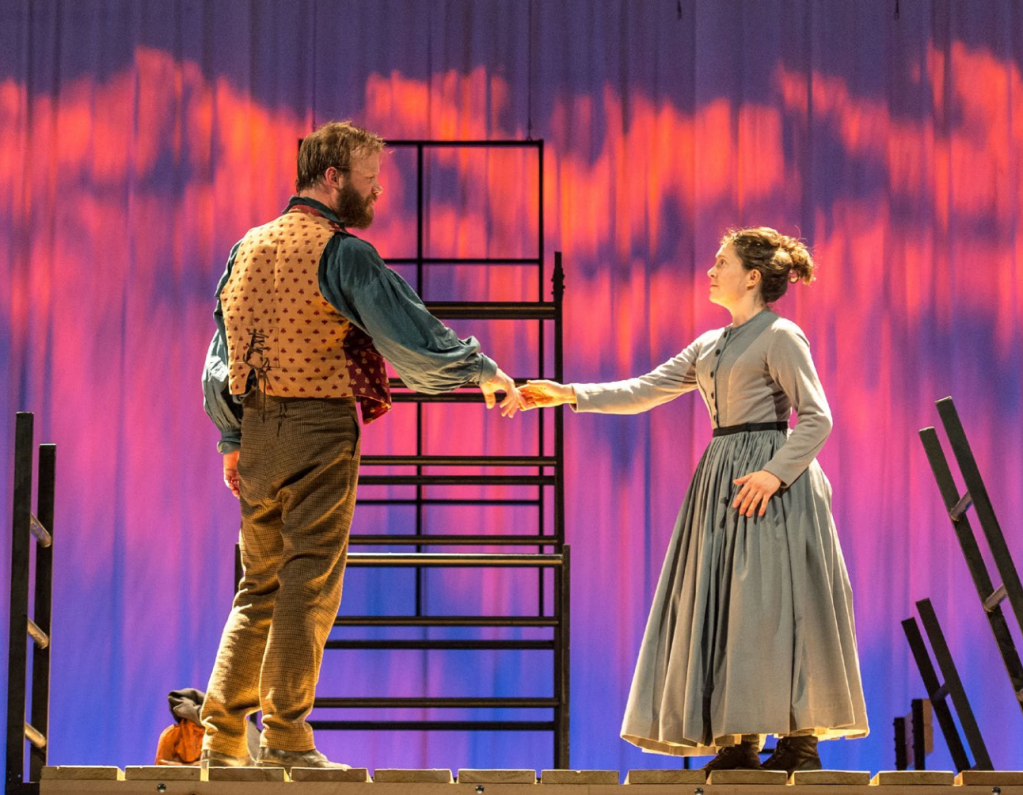
In this photo from the production, warm, pink lighting is projected onto the background, to create an inviting and ‘safe’ feeling environment, and emphasising Jane and Rochester’s romance.

Posted in Class Work

Mime Movement Task

In this class, we researched the origins of Mime movement, and how it is still used and prevalent in modern works today. Mime is a theatrical form used to suggest actions, create characters, and tell stories, all without speaking. Mime focuses on body movement, and the power to convey a character by only using body definitions. In our Laban workshop, we learnt more about using body movement to represent a character. We explored the three key components of mime, also known as ‘the 3 Fs of mime’, Force, Face, and Focus. We experimented with different kinds of mime tasks, such as ‘pulling a rope, ‘climbing up stairs and ladders’, ‘lifting/using an object’, etc. Each having the ‘three Fs’ as key components to making the task look realistic. For example, in the ‘pulling a rope’ task, there was a large emphasis on force, as we need to look like we’re pulling really tightly on the imaginary rope. We want our focus to be on it, so it puts more emphasis on the rope and looks more realistic to the audience. Facial expressions are also extremely vital, depending on the character (struggling, finding it easy, etc.) to further place importance on the rope and create an overall tone and atmosphere for the mime character we are playing.

Posted in Class Work

Malcolm’s Laban Workshop

In this perod we learnt about the histroy of Rudof Laban, a dance artist and theorist from the early 20th century. He was a key person in changing the landscape for choereography in dance and other performing arts. He put a large emphasis on how we move our bodies in context to our character and emotions, and created 8 different ‘personality styles’ to define how your character/emotions would appear on stage. He dvided these peronsality types according to certain dynamics, these being: Weight, Space, and Time. I indetnified mostly with the flick and the punch, typically having ‘sudden’ movements. I’d least identify witth the wring, heavy yet flexible movements aren’t common for me. These personalities help us bring charcaters from a script to life, and help the actor identify with them more.

Posted in Class Work

Theatre Studies Retreat

The first day of the retreat was much more theory focused. We first learnt about R.E.M.V.Co.Co, the essential conventions of theatre. This includes rhythm, emphasis, movement, variation, contrast, and cohesion. We then broke into groups to display a tableau using one of the conventions, my group’s convention was ’emphasis’, so for example, we would go into positions where one member of the group would stand up, while the rest of the members sat on the floor and pointed to the one person standing, adding emphasis on that person.

Rinski Ginsberg, one of our teachers was an expert at VCA and taught us about body movement in acting, and improvising without speaking. In this class, we learnt about how small actions can make big differences, and can replace dialogue sometimes.

Later in the day, we had VCA graduates arrive to teach us stage combat, and Josh, a professional fight director, taught us how to stage a fight scene. They showed us simple tips and tricks that give big effects.

Later that night, we watched a live performance of Shakespeare’s The Twelfth Night. This show was really eye-opening, and it was nice to see a professional production now working on one ourselves. The show was an example of how props/sets can be used in different ways, and had lots of different comedic and musical segments.

The next morning, we focused on the ‘birth scene’ in Frankenstein, starting off with an exercise to get into The Creature’s character and try to act out what it would feel like to ‘come alive’. This included feeling the body and its movements, looking around, picking up items, eventually learning how to stand and walk. It felt foreign and strange, but help us be put into a new perspective.

We later began working on the Planning/Research stage of our Production I See Monsters. My group was given the script of Salome by Oscar Wilde to read through and annotate. Much of the language in the play was dated and at times difficult to understand, however, we were able to cut out large, unnecessary parts of the play, and make it easier to understand for the future group performing Salome.

Later in the day, we focused on the script of Frankenstein (one of the plays featured in I See Monsters), and broke off into small groups to choreograph the opening scene of the Play. With was crucial for teaching us how body movement was vital in theatre, and could tell stories with little to no dialogue.

Posted in Class Work

Elizabethan Theatre (Class Work)

In the last week, we’ve learnt about Elizabethan theatre and some of the conventions and characteristics that made the era unique. In one class, we learnt about how Elizabethen era turned ‘insulting’ someone into an art, and had to practice it with each other. Along with insulting each other, we focused on famous Shakespearean plays, featured in our own school’s production ‘Ladies In Arms’. My group performed an extract from Much Ado About Nothing, with me playing Benedick. While rehearsing and performing his character, I’ve learnt a lot about Shakespeare’s writing, and the actual meaning behind his plays. I’ve also learnt about acting techniques, specifically about memorising scripts in a short amount of time.