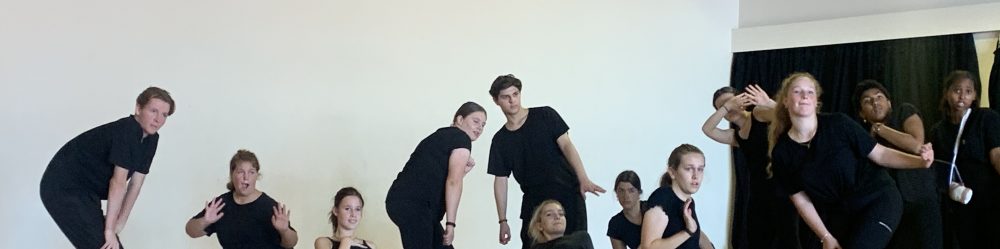
In this perod we learnt about the histroy of Rudof Laban, a dance artist and theorist from the early 20th century. He was a key person in changing the landscape for choereography in dance and other performing arts. He put a large emphasis on how we move our bodies in context to our character and emotions, and created 8 different ‘personality styles’ to define how your character/emotions would appear on stage. He dvided these peronsality types according to certain dynamics, these being: Weight, Space, and Time. I indetnified mostly with the flick and the punch, typically having ‘sudden’ movements. I’d least identify witth the wring, heavy yet flexible movements aren’t common for me. These personalities help us bring charcaters from a script to life, and help the actor identify with them more.
Monolouge Refections
To create my monolouge, I used Jokanaan’s dialouge from Salome and edited parts to fit it together as one piece. In the play, Jokanaan is in the bottom level of the castle, he is headless and sits inside a water tank. For my rendition of this character, I visualised what would be going inside his head, in my performance, Jokanaan walks around, looks through his surroundings, punches the air, etc. Inerpreting the script as if his body was whole. In my perforance, I used movement to express the context of the scene and Jokanaan’s true feelings. I took Insapration from Rochester in Jane Eyre, played by Felix Hayes. I took on a samiliar accent, attributes, etc. While still keeping in my own character.
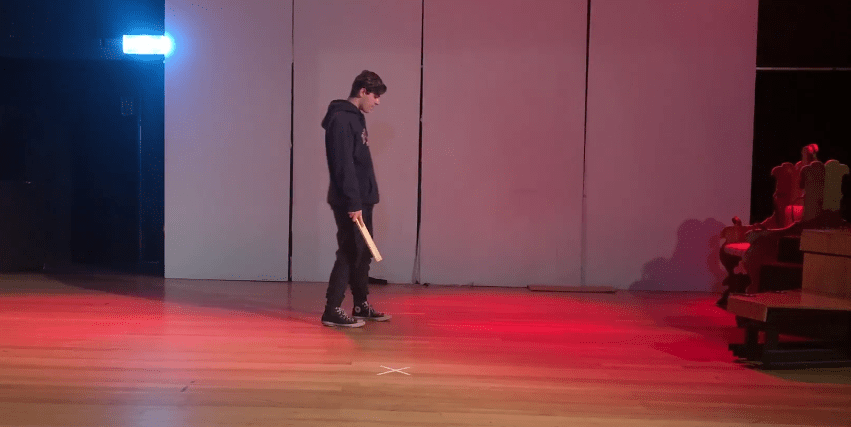
https://drive.google.com/file/d/1mXLk_8Q_WN5RMSL308hqG8TfcqT1EI0h/view?usp=sharing
Frankenstein – Lighting
In our production of Frankenstein, we’ve used various different lighting techniques to convey the films message and symbolise the key themes about monstrosity and power. Lighting is vital in theatre as it can help emphasise parts of the scene, stress tension or fear, evoke emotions, and deeply enhance a piece of theatre.
In the opening scene ‘The Creature’s First Steps’, all light is blacked out, with a single white spotlight shining on the creature, in aims to symbolise the oblivious and naive nature of the creature. However, when Frankenstein appears and starts shouting at the creature, the lighting changes, the piano music stops, and dull lighting fills the set, representing the dull atmosphere the creature has been brought in. We use cool colours in emotional parts of the scene, such as the ending, where Frankenstein’s father realises what he’s son’s done. These cool tones help stress the feeling of isolation and sadness, whereas in other scenes, that depict murder/torment, we use red LEDs to exaggerate the fearful moment, and create tension and anxiety on stage.
In contrast, Frankenstein has been redone using many different kinds of theatre lighting in productions in the past. In the 2011 adaption from Danny Boyle, 3,000 filament light bulbs were used to light up the ceilings in scenes. Though this wouldn’t be something we’d be able to recreate in our production, this is a unique concept we could try to modify and incorporate.

Production Role: Lighting & Sound
The Production Role I’ve chosen for our show I See Monsters, is lighting and sound. As I’ve learned, this is an extremely vital part of the productions we perform at our school, and in theatre as a whole. Lighting can evoke emotions, reactions, and emphasise parts, or a whole scene. In I See Monsters, our L+S crew have decided to give each play from the 4 a different colour pallete. We do this to not only differentiate the plays in I See Monsters, but also evoke different emotions from the audience, and create a specific mood and atmosphere.
For example, in Pygmalion, a romantic-comedy style play, though most of the lighting will be naturalistic, we’ve chosen light pink as it’s ‘main colour’, to symbolise romance, and a generally happy play. In Dr. Faustus, we’ve chosen to colour red, and it is focused on lucifer and demons. In Frankenstein, we’ve chosen green, and Blue for Salome.
Currently, we are still focusing on improving our lighting skills, learning how to properly use the lighting program and create cues to play on stage. We are particularly looking at LED lights and their impact on stage, compared to other coloured lighting like the spotlights, and how we can incorporate them into our production. We’ve also been experimenting with different effects, including the disco ball, to create a Theatre Of Cruelty inspired effect. As of now, we are at the beginning stage of creating the official lighting cues that will be used in the production.
Mary Shelley: Study

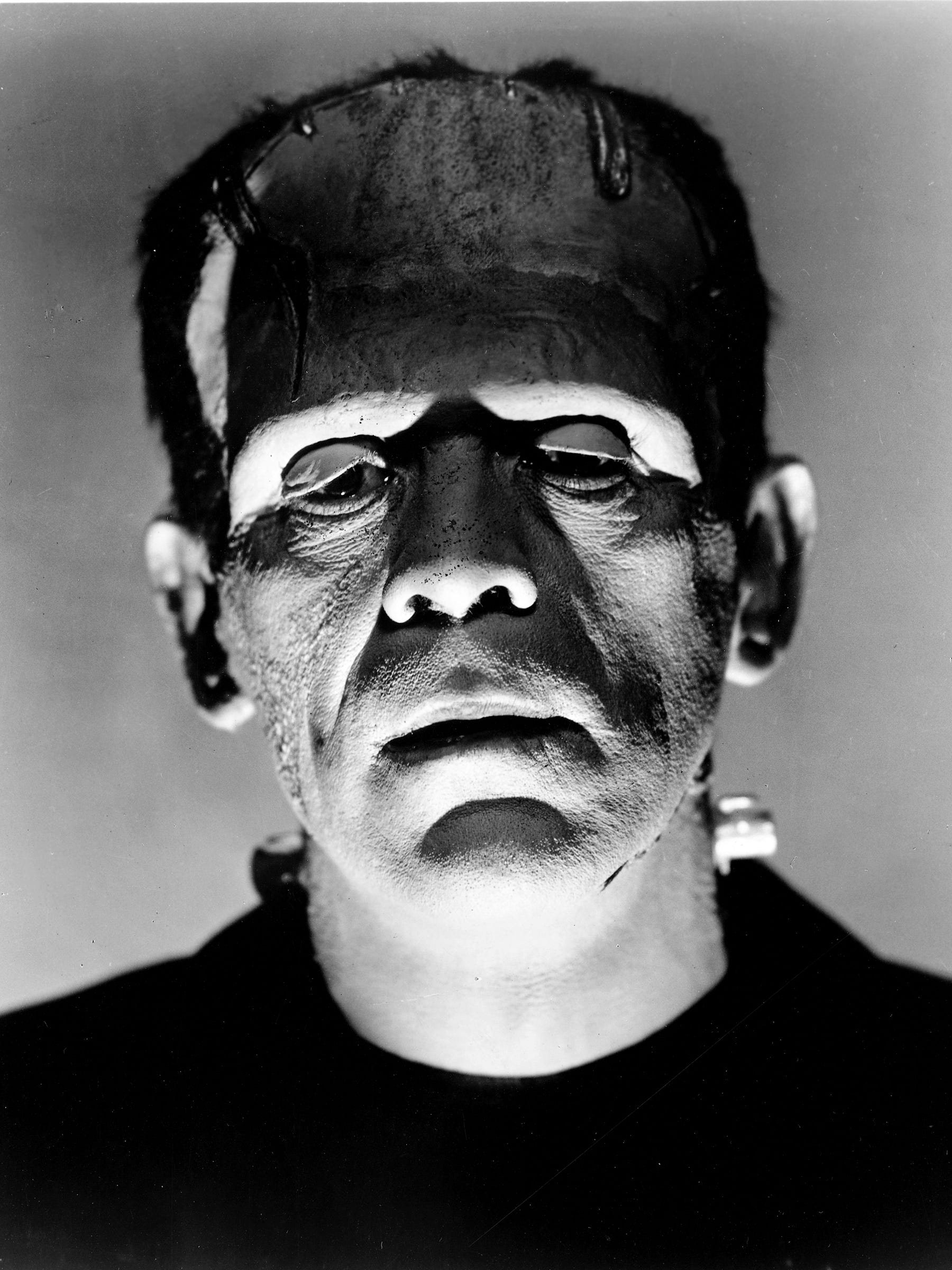
Mary Shelley, born August 1797, was an English author best known for her novel and playwright, Frankenstein. Frankenstein first gained traction when it was entered into a young-writers contest, were novelists had to compete to write the best horror story; and Shelley’s, once published, became immensely successful. People feared Frankenstein because it was often though something similar could take place in real life, and the way it manages to cover dark and serious topics captivated many.
Frankenstein however, is also known for its much deeper meaning. At the beginning on the story the create is innocent, and means no harm. However, after being exposed to the harsh world and wrong doings of Victor, the creature becomes evil, and learns from what he’s seen. Shelley’s story helped to reflect on society, and how man can be just as evil if not more than an ‘ugly beast’ and how strong our influence can truly be on others. Even to someone as innocent and oblivious as the creature.
Rehearsals: Pygmalion & Salome
As we have begun the development stage of our production I See Monsters, we have begun rehearsals for the production. I play Colonel Pickering in Pygmalion, Jokanaan in Salome, and Victor’s father in Frankenstein. In Act 2 of I See Monsters, I particularly have a lot of quick changes, so it’s something I’ll need to especially prepare for.
Pickering is the sidekick for the main antagonist, Henry Higgins. This role depicts an upper-class ‘snob’ kind of character, and requires me to have very proper mannerisms, and speak in a posh British accent. My main focus for Pickering however, is that though he has few lines, he is still featured in many scenes, engaging with the current situation to support Henry. Because he has a lot of stage time with little dialogue, I need to focus deeper on his mannerisms and reactions to what’s happening in scenes to still give his character life and personality, and still keep him as a vital part of the scene.
Playing Jokanaan in Salome is my biggest challenge, a lot of the dialogue is dated, and especially difficult to understand. To improve, I need to research more into the script to truly understand everything being said, so I can express it right on the play. This is something we (the Salone cast as a whole) can improve on together as a group. Jokanaan’s staging is also quite different to a regular play, as I won’t be moving much but sitting down as I play a ‘floating head’. This will be even more challenging as I won’t be able to emphasise Jokanaan’s emotions through body movement, and will have to rely heavily on facial expression and tone in the dialogue.
Victor’s father in Frankenstein is a smaller role, however he is a vital character towards the end of the play. He was once very loving towards his son, yet it quickly changes to sadness and especially disappointment. As Victor’s father also has the last lines in the Frankenstein, I want to truly embody the emotions Victor’s father would’ve felt, keeping them big, yet emotive and realistic.
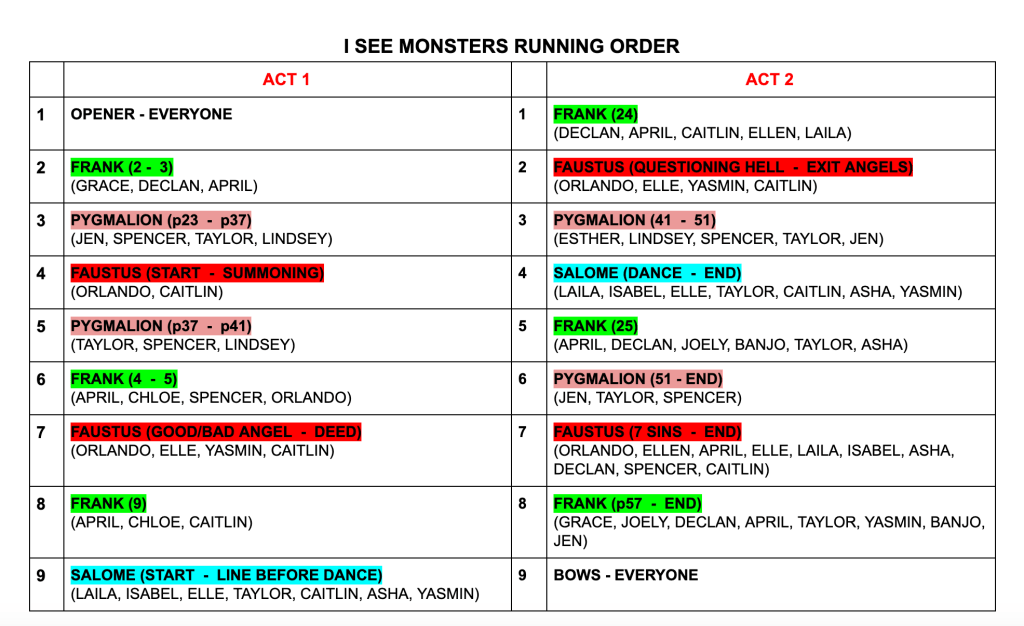
Pickering: Character Profile
As we are currently in the Development stage of our production I See Monsters, we have begun to create character profiles for our roles in the production. This helps us get a feel of our character and who we’re playing.
Pickering – Role: Henry Higgins’ Sidekick
In social situations, Pickering is often a follower. Especially when it comes to Henry Higgins, he looks up to him in almost a Godly way, and believes Henry is full of wisdom. He often agrees with him and has similar views to him, but he’s not afraid to call him out if he’s getting out of hand. Pickering is part of the upper class, he’s quite a snob and looks down at the lower classes. Even laughing at them at times. However, throughout the play, and getting to Eliza better, he too does realise they are still human when it goes too far. At the end of the play, he even apologises to Eliza, showing that he does have a caring side to him. Movement wise, he sits and walks very properly, further establishing his social class. He sits with a good posture, however at home he can relax a little more.

Theatre Studies Retreat
The first day of the retreat was much more theory focused. We first learnt about R.E.M.V.Co.Co, the essential conventions of theatre. This includes rhythm, emphasis, movement, variation, contrast, and cohesion. We then broke into groups to display a tableau using one of the conventions, my group’s convention was ’emphasis’, so for example, we would go into positions where one member of the group would stand up, while the rest of the members sat on the floor and pointed to the one person standing, adding emphasis on that person.
Rinski Ginsberg, one of our teachers was an expert at VCA and taught us about body movement in acting, and improvising without speaking. In this class, we learnt about how small actions can make big differences, and can replace dialogue sometimes.
Later in the day, we had VCA graduates arrive to teach us stage combat, and Josh, a professional fight director, taught us how to stage a fight scene. They showed us simple tips and tricks that give big effects.
Later that night, we watched a live performance of Shakespeare’s The Twelfth Night. This show was really eye-opening, and it was nice to see a professional production now working on one ourselves. The show was an example of how props/sets can be used in different ways, and had lots of different comedic and musical segments.
The next morning, we focused on the ‘birth scene’ in Frankenstein, starting off with an exercise to get into The Creature’s character and try to act out what it would feel like to ‘come alive’. This included feeling the body and its movements, looking around, picking up items, eventually learning how to stand and walk. It felt foreign and strange, but help us be put into a new perspective.
We later began working on the Planning/Research stage of our Production I See Monsters. My group was given the script of Salome by Oscar Wilde to read through and annotate. Much of the language in the play was dated and at times difficult to understand, however, we were able to cut out large, unnecessary parts of the play, and make it easier to understand for the future group performing Salome.
Later in the day, we focused on the script of Frankenstein (one of the plays featured in I See Monsters), and broke off into small groups to choreograph the opening scene of the Play. With was crucial for teaching us how body movement was vital in theatre, and could tell stories with little to no dialogue.
Elizabethan Theatre (Class Work)
In the last week, we’ve learnt about Elizabethan theatre and some of the conventions and characteristics that made the era unique. In one class, we learnt about how Elizabethen era turned ‘insulting’ someone into an art, and had to practice it with each other. Along with insulting each other, we focused on famous Shakespearean plays, featured in our own school’s production ‘Ladies In Arms’. My group performed an extract from Much Ado About Nothing, with me playing Benedick. While rehearsing and performing his character, I’ve learnt a lot about Shakespeare’s writing, and the actual meaning behind his plays. I’ve also learnt about acting techniques, specifically about memorising scripts in a short amount of time.
Charlotte Brontë
Born in Thornton, United Kingdom, in April 1816, Charlotte Brontë is an English poet and novelist, best known for her book’ Jane Eyre’. First published in 1847, the novel’s story has been passed on for decades and in the 1990s, was adapted into a theatrical play.
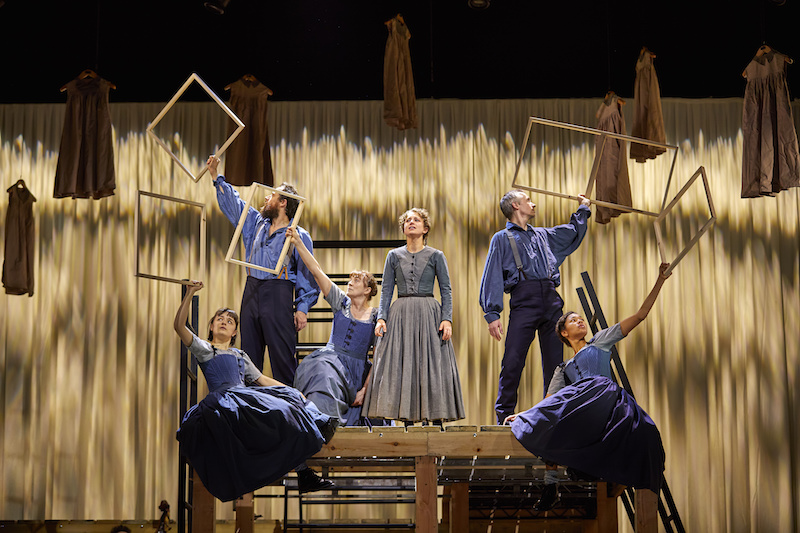
Jane Eyre was originally a gothic story set in the 19th century about an orphan trying to find independence and get out of her poor situation. As it was written and set in the 19th century, the costumes and sets are no different. The sets were also inspired by this era.
The sets used in Jane Eyre were also known for being unique. This included the use of wooden props and furniture, like platforms, ramps, and even metal ladders

Bibliography:
Gillinson, M. (2017). Jane Eyre at the National Theatre. [online] Exeunt Magazine. Available at: http://exeuntmagazine.com/reviews/review-jane-eyre-national-theatre/ [Accessed 30 Jan. 2020].
Gilbert, J. (2017). Jane Eyre, National Theatre review. [online] Theartsdesk.com. Available at: https://theartsdesk.com/theatre/jane-eyre-national-theatre-review-dynamic-treatment-just-misses [Accessed 30 Jan. 2020].
 Taylor's Document Diary - VCE Theatre Studies 2020